

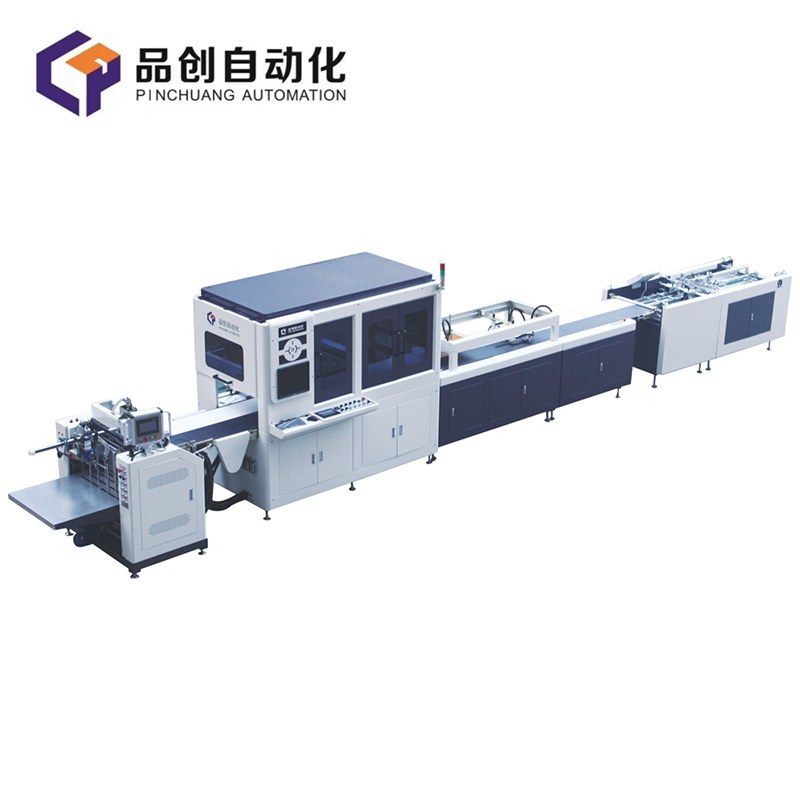
A rigid box making machine supplier has to be evaluated on two separate axes: whether the machine suits your box range, and whether the supply side keeps its promises after the deposit clears. Most buyers assess the first thoroughly and the second hardly at all.
This guide covers both. It sets out the technical questions worth asking, the trial that should happen before you commit, and the warning signs that appear in quotations long before they appear on the shop floor. We write it from the supplier side at Pinchuang, so the checks below are the ones we expect a serious buyer to run on us.
How to Evaluate a Rigid Box Making Machine Supplier on Two Axes
Machine fit and supply reliability fail in different ways, so they need separate questions. A supplier can be excellent on one and weak on the other.
| Axis | What it decides | How to test it |
|---|---|---|
| Machine fit | Whether your box sizes and materials run at the quoted speed | Sample box trial on your own board and wrap |
| Supply reliability | Whether the machine arrives as specified and keeps running | Delivery schedule, parts list, acceptance criteria |
A quotation that answers the first axis in detail and waves at the second is the most common pattern in the market, and it is worth treating as a warning rather than a bargain.
Questions to Ask About Lead Time, Tooling and Spare Parts
These are the three areas where a supplier's answer either becomes specific or stays vague, and the difference tells you a great deal.
Lead time
Ask for the schedule split into stages: build, test run, packing, shipping and installation. A single number covers everything and commits to nothing. You want to know which stage absorbs delay, and what happens to the schedule if a mould has to be modified for your box size after the order is placed.
Tooling
Ask which moulds are included and which are chargeable, and ask for a drawing of the mould used for your smallest box. Tooling is where a low headline offer is recovered, and it is also the area where an inexperienced buyer is most exposed, because a machine without the right mould cannot run the job it was bought for.
Spare parts
Ask for an itemised first-year parts kit, station by station, with part numbers that appear on the machine drawing. Then ask who holds those parts in stock. A supplier that can walk you through a forming mould, a tape head or a glue roller by name is speaking from a parts shelf; one that cannot is speaking from a brochure.
Trial a Sample Box Before You Commit
A sample box trial is the cheapest risk reduction available, and it should be run on your own materials rather than on the supplier's ideal stock.
- Send three sizes, not one. Your smallest, your largest and a typical mid-range box. A machine that behaves well at the middle of its range can still struggle at the extremes.
- Send your actual board and wrap. Precision figures are quoted against particular materials. Greyboard thickness and wrap weight both change how a box behaves at the forming station.
- Ask for the run to be filmed in one take. A continuous clip of twenty boxes coming off the machine tells you more about speed and stability than a set of staged photographs.
- Ask for the pieces themselves. Have the sample boxes packed with the consignment and inspect them at your own factory, in your own light, with your own quality thresholds.
The trial also exposes the supporting stations. If your boxes need pre-scored board or an even glue film, the trial will show whether the V-grooving and gluing stations were set up properly, or whether the result depended on hand work that will not exist in production.
Documentation and Handover
The handover package is where a supplier relationship is either finished properly or left half open, and it is cheap to specify in advance. Ask for four things and hold the final payment against them.
- A manual that matches the frame. Wiring schedule, pneumatic diagram and the revision of the control software that was actually loaded, not a generic document from an earlier build.
- Changeover sheets for every size you buy. One page per box size, recording mould settings, speed, glue setting and any station adjustments. This is what makes a size change repeatable a year later when the original operator has moved on.
- A parts list keyed to the drawing. So that a replacement can be ordered by number instead of by photograph and description.
- A named route for technical questions. Not a general sales address, but a way to reach someone who can read the diagnostics on your control system.
Plants that ask for these four items at the quotation stage usually find that they cost nothing and save a great deal, because they convert an informal relationship into a documented one. At the same time, a machine that arrives without them can still be run, but every future fault becomes a conversation from scratch rather than a lookup.
Red Flags in a Quotation
None of the following items is a price, and none of them is negotiable in the way a price is. Each one is a structural signal.
- A speed figure with no size stated. Production speed on a rigid box machine depends on box size and wrap material. A number without those conditions is marketing.
- No precision figure at all. Positioning precision drives waste on patterned wraps. If a supplier will not quote it, ask which positioning method is fitted and what it holds.
- Tooling described as “standard”. Standard for which box? Tooling should map to your size band, and the mapping should be written down.
- A delivery date that assumes nothing. No allowance for mould modification, no test-run window, no packing time.
- No acceptance criteria. If nothing is written about the test run, nothing can be enforced at the end of it.
What a Stable Supply Side Looks Like
Pinchuang has supplied this equipment from Dongguan since 2008. Production runs from a 10,000 m² facility with more than 100 employees, and machines ship to over 30 countries. We exhibit at All in Print China, Printing South China, China Print, Drupa, SINO FOLDING CARTON and WEPACK.
Those details are not decoration; they are the parts of a supplier's profile that can be checked independently. A supplier that has been building the same platform for years can tell you what changed between revisions and why. That kind of answer is what a buyer is really paying for, because the machine on your floor will be supported by the same people for as long as you run it.


Both configurations sit on the same rigid box making machine platform and take the same tooling family, which matters if your order book changes size bands between seasons. Where corner strength is the deciding factor, the upstream corner pasting station is usually the first piece of equipment to review, because a weak corner cannot be corrected later in the line.
Common Questions About Supplier Evaluation
How many quotations should I compare?
Two or three is normally enough if you read them properly. The value is not in the spread of offers but in watching how each supplier answers the same technical question. Ask all of them for the positioning precision on your smallest box and compare the specificity of the replies.
Should I buy the whole line at once?
Rarely. Most plants start with the forming or box making machine and add gluing, grooving and corner pasting as volumes justify them. Buying every station on day one locks in capacity you may not be able to feed, and it makes the first fault harder to trace.
What if my sizes fall outside the standard range?
Say so at the quotation stage rather than after ordering. A manufacturer can usually adjust tooling and limits; a trader cannot. Either way, the answer belongs in the written specification, together with the box sizes it applies to.
Is a lower offer worth pursuing?
Only if the specification behind it is identical. Where two offers differ, the difference is almost always in tooling scope, control system or the parts list — all of which are cheaper to settle before the order than after installation.
Send Pinchuang your three extreme box sizes, your board and wrap, and your target output. We will reply with a configuration, its honest limits and the tooling it needs — so that you can measure every rigid box making machine supplier you are considering on the same written facts.
Send your three box sizes See the platforms we build